
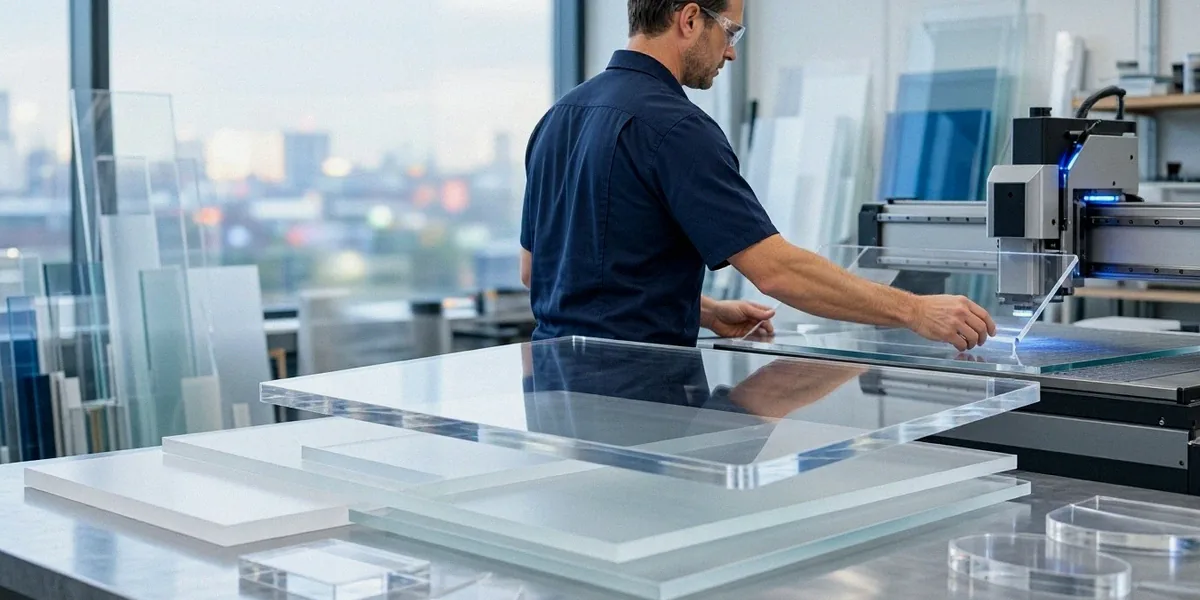
Acrylic Sheet and Perspex Fabrication: A Practical Guide for UK Makers and Businesses
You’ve spent weeks planning a project. Maybe it’s a set of retail display stands, a run of laser-cut signage, or a custom splashback for a client’s kitchen. You order what you think is the right plastic sheet, it arrives, and within an hour you realise you’ve made a costly mistake. The material crazes when you drill it. The edges turn cloudy after laser cutting. It yellows within a few months in a sunny window. We’ve seen it happen to hobbyists and professional fabricators alike, and it almost always comes down to one thing: not fully understanding the material before the first cut. That’s exactly why we’ve put together this guide. Whether you’re a small workshop in Manchester, a design studio in Bristol, or a business sourcing acrylic displays at scale, we’ll walk you through everything from choosing between acrylic sheet and Perspex to laser cutting settings, fabrication techniques, UK suppliers, and sustainability considerations. By the end, you’ll have the practical knowledge to pick the right sheet, cut it cleanly, and finish it to a standard your clients will notice.
Understanding Acrylic Sheet and Perspex: What UK Makers Need to Know
Before we get into cutting, drilling, and polishing, we need to clear up some terminology that trips up a surprising number of people. In the UK, you’ll constantly hear the words “acrylic sheet” and “Perspex” used as if they’re interchangeable. Most of the time, that’s fine in casual conversation, but when you’re specifying materials for a paid job, the distinction matters. Understanding what you’re actually buying will help you predict how it behaves under a laser, a router, or a heat gun, and it will stop you from overpaying for a brand name when a generic sheet would do the job perfectly well.
Acrylic vs. Perspex: Is There a Difference?
Let’s start with the simple answer: Perspex is acrylic, but not all acrylic is Perspex. Acrylic sheet is the generic term for a transparent thermoplastic made from polymethyl methacrylate, usually shortened to PMMA. It’s sold under dozens of trade names around the world, including Plexiglas in the United States and Lucite in some markets. Perspex is one of those trade names, and it’s the one that stuck in the UK.
Here’s the part that matters for UK makers: Perspex is a UK-manufactured brand by Lucite International. It has been produced in Britain for decades, and it’s widely regarded as a benchmark for consistent quality, particularly in its cast form. When you buy Perspex from a UK supplier, you’re typically getting a sheet with tightly controlled thickness tolerances, excellent optical clarity, and predictable behaviour under laser cutting and machining. Generic imported acrylic can be just as good, but batch-to-batch consistency varies more, and that inconsistency shows up when you’re running production work.
So should you always buy Perspex? Not necessarily. For prototyping, jigs, or non-critical applications, a standard cast or extruded acrylic sheet will often do the job at a lower cost. But for retail displays, architectural glazing, or anything where clarity and longevity are part of the brief, specifying Perspex by name gives you a known quantity. We generally recommend that makers working on client-facing projects stick with branded sheet until they’ve built up enough experience to judge unbranded material confidently.
Key Properties: Clarity, Strength, and Weathering
Why does acrylic dominate so many fabrication projects in the first place? It comes down to a combination of properties that few other materials can match at the price point.
- Optical clarity: Acrylic transmits around 92% of visible light, which is higher than standard glass. It also has a lower refractive index, so thick sheets don’t distort what’s behind them as much as glass does. This is why acrylic displays look so clean in retail environments.
- Impact resistance: Acrylic is roughly ten times more impact-resistant than glass of the same thickness. It won’t shatter into dangerous shards; it cracks or chips instead. That said, it’s not indestructible, and sharp impacts on edges can still cause fractures.
- UV stability: Good quality acrylic, including Perspex, is formulated to resist UV degradation. It won’t yellow or become brittle after years of sun exposure the way some cheaper plastics do. This makes it suitable for outdoor signage, window displays, and architectural features.
- Weight: Acrylic weighs roughly half as much as glass of equivalent thickness, which matters for exhibition stands and anything that needs to be transported regularly.
- Thermoformability: Acrylic softens at around 150–160°C, which means it can be bent, draped, and vacuum-formed into curved shapes without losing clarity.
The trade-off is scratch resistance. Acrylic scratches more easily than glass, so finishing and handling matter. We’ll cover polishing and protective films later in this guide.
Common Thicknesses and Sheet Sizes for UK Projects
UK suppliers typically stock acrylic sheet in a range of thicknesses, and knowing which one to reach for saves both money and frustration. Here’s a rough guide based on what we see most often in fabrication work:
- 2mm: Light signage, protective covers, model making, and small display inserts.
- 3mm: The workhorse thickness for laser cutting. Ideal for point-of-sale stands, brochure holders, and decorative panels.
- 5mm: Retail displays that need more rigidity, medium signage, and shelving.
- 6–10mm: Exhibition stands, structural display components, and furniture elements.
- 12–25mm: Architectural glazing, heavy-duty displays, and machined components.
Standard sheet sizes in the UK are usually 2440mm x 1220mm (8ft x 4ft) and 3050mm x 2050mm, though smaller cut-to-size options are widely available. If you’re ordering from a supplier like Simply Plastics or Trent Plastics, you can often specify exact dimensions and they’ll cut the sheet down for you, which saves you from wrestling with a full 8×4 sheet in a small workshop. We’d strongly recommend this for anyone without a proper panel saw setup.
Laser Cutting Acrylic: Techniques, Tips, and UK Suppliers
Laser cutting is where acrylic really shines. Unlike many materials, acrylic vaporises cleanly under a CO2 laser, leaving a polished, glass-like edge that often needs no further finishing. That’s a huge advantage for anyone producing display components, signage, or intricate decorative pieces. But the process isn’t foolproof. Get your settings wrong and you’ll end up with cloudy edges, bubbled surfaces, or hairline cracks that only show up days later. Let’s break down how to get it right.
Choosing the Right Acrylic for Laser Cutting
The single most important decision you’ll make before cutting is cast versus extruded acrylic. Both can be laser cut, but they behave differently, and for most quality-focused work, cast wins.
Cast acrylic is made by pouring monomer between glass plates and allowing it to polymerise. This produces a sheet with excellent optical clarity, consistent thickness, and a higher melting point. When laser cut, cast acrylic produces a clean, frosted-to-polished edge and engraves with a bright, high-contrast white mark. Perspex cast acrylic is the gold standard here, and it’s what we recommend for any project where edge quality and engraving contrast matter.
Extruded acrylic is made by pushing molten polymer through a die. It’s cheaper, has tighter thickness tolerances, and cuts faster. However, it tends to produce a sharper, more brittle edge under laser cutting, and it engraves with a less pronounced contrast. It’s fine for simple cut-out shapes where the edge won’t be closely inspected, but for retail displays and exhibition work, cast is the safer choice.
One more consideration: always check whether your sheet has a protective film on both sides. Most quality acrylic does, and you should leave it on during cutting to protect the surface from smoke and spatter. Just be aware that some films are laser-safe and some aren’t, so confirm with your supplier.
Laser Settings and Techniques for Clean Edges
Every laser cutter is different, so any settings we give you are a starting point, not gospel. You’ll need to run test cuts on offcuts of the exact material you’re using. That said, here’s the general approach we follow for CO2 lasers cutting acrylic sheet:
- Power and speed: For 3mm cast acrylic on a typical 60–80W CO2 laser, start around 60–70% power and 15–20mm/s speed. Thicker material needs slower speeds and more power; thinner material needs faster speeds to avoid melting.
- Air assist: Use it. Air assist blows away vapourised material and prevents flare-ups, which are a real risk with acrylic. It also keeps the cut edge cleaner.
- Focus: Focus precisely on the top surface of the sheet. Defocusing slightly can help with engraving, but for cutting, sharp focus gives the narrowest kerf and cleanest edge.
- Multiple passes: For thicker sheets (10mm and above), multiple passes at moderate power often produce better results than one aggressive pass. It reduces the risk of edge charring and internal stress.
- Bed height: Raise the sheet slightly off the honeycomb bed if you can. This reduces backside reflection and gives a cleaner bottom edge.
Common pitfalls to watch for: too much power causes bubbling and a rough edge; too little power leaves a cloudy, unfinished cut; excessive speed leaves striations. If you see fine cracks radiating from the cut edge, your material is likely under stress, which often points to extruded acrylic or a sheet that’s been stored badly.
UK Laser Cutting Services and What to Expect
Not everyone has a laser cutter, and even those who do sometimes need to outsource large or complex jobs. Fortunately, the UK has a strong network of laser cutting services. UK laser cutting services like Cut Laser Cut and Hobarts offer precision cutting for acrylic sheet, and both have solid reputations for quality and turnaround.
When you approach a laser cutting service, here’s what to have ready:
- A vector file (DXF, SVG, or AI) with clean, closed paths.
- The exact material specification, including whether you want cast or extruded, and the brand if it matters.
- Thickness, sheet size, and quantity.
- Any tolerance requirements, especially for parts that need to fit together.
- Whether you want the protective film left on or removed.
Typical turnaround for small jobs is 3–5 working days, though many services offer express options. Pricing is usually based on cutting time plus material cost, so simpler designs with fewer pierce points are cheaper. It’s worth getting quotes from two or three suppliers for anything substantial, as rates vary quite a bit across the country.
Designing and Fabricating Acrylic Displays for Retail and Exhibitions
Acrylic displays are one of the most commercially important applications of the material, and for good reason. They’re clean, modern, durable, and they present products in a way that glass often can’t match because of weight and safety concerns. From a single countertop stand in a boutique to a full exhibition build at a trade show, acrylic sheet is the material of choice for brands that care about presentation.
Types of Acrylic Displays: From Countertop to Floor Standing
The range of display formats you can build from acrylic is enormous, but most fall into a few recognisable categories:
- Countertop point-of-sale stands: Small tiered stands, card holders, and product risers. Usually 3–5mm acrylic, often with a bent or bonded base.
- Brochure and leaflet holders: Wall-mounted or free-standing, typically 3mm acrylic with a folded or bonded pocket.
- Shelving units and risers: Multi-tier displays for cosmetics, jewellery, or electronics. Usually 5–10mm for rigidity.
- Floor-standing display stands: Larger units for retail floors and exhibition halls, often 10mm+ with metal or wooden structural elements.
- Exhibition and trade show stands: Custom-built acrylic elements integrated into larger stand designs, including signage, product plinths, and barriers.
- Protective screens and dividers: Still common in retail and hospitality settings, usually 5–6mm acrylic with polished edges.
UK retail brands like Selfridges use acrylic displays for point-of-sale and exhibitions, and the NEC Birmingham hosts exhibitions where acrylic displays are commonly used across every sector from fashion to industrial equipment. If you’re designing for these environments, the material needs to look flawless under bright lighting and survive being handled, moved, and reassembled repeatedly.
Fabrication Techniques: Bending, Bonding, and Finishing
Building a display isn’t just about cutting flat shapes. The magic happens in the forming and joining. Here’s how we approach the three core techniques.
Bending. Acrylic can be bent along a straight line using a strip heater or a heated wire bender. The sheet is heated along the bend line until it becomes pliable (usually 2–5 minutes for 3mm), then folded to the desired angle and held until it cools. For tighter radii or complex curves, you’ll need a line bender with a curved element or a vacuum-forming setup. The key is even heating; uneven heat causes stress marks and cloudy bends.
Bonding. There are two main approaches. Solvent bonding uses a liquid like dichloromethane (often sold as Tensol or similar) that chemically welds the acrylic surfaces together. It produces a nearly invisible joint but requires precise alignment and good ventilation. Adhesive bonding uses a product like Evostik or a two-part acrylic adhesive, which is more forgiving but leaves a visible glue line. For retail displays where aesthetics matter, solvent bonding is usually the better choice.
Finishing. After cutting and bonding, edges often need polishing to restore clarity. Flame polishing uses a small torch to melt the edge surface, producing a glossy finish quickly but risking stress cracks if done carelessly. Mechanical polishing with progressively finer abrasives and a buffing wheel is slower but safer and gives more control. For display work, we usually recommend mechanical polishing followed by a final flame pass on straight edges.
Case Study: Acrylic Displays for UK Retail Environments
Let’s make this concrete. Imagine a mid-sized UK cosmetics brand preparing for a trade show at the NEC Birmingham. They need a modular display system that can be assembled in under an hour, transported in a standard van, and look premium under exhibition lighting.
The build might use 6mm Perspex cast acrylic for the main vertical panels, 5mm for shelves, and 3mm for branded signage inserts. Shelves are solvent-bonded to the verticals with hidden joints, and the whole structure sits on a bonded acrylic base with adjustable feet. Edges are mechanically polished, and the front-facing signage is laser-engraved for a frosted effect. The client also orders a set of smaller countertop versions for use in Selfridges and other retail stockists, using the same design language at a smaller scale.
This kind of project is typical of what we see in the UK market. It combines laser cutting, bonding, polishing, and careful material selection, and it’s exactly the sort of work where specifying Perspex rather than generic acrylic pays off in consistency across multiple production runs.
Plastic Fabrication Essentials: Cutting, Drilling, and Finishing Acrylic
Not every acrylic project goes near a laser. Plenty of fabrication work involves saws, routers, drills, and hand tools, and this is where a lot of makers come unstuck. Acrylic behaves differently from wood or metal, and techniques that work fine on other materials will ruin a sheet of acrylic in seconds. Here’s how we approach the fundamentals.
Cutting Acrylic Sheet: Sawing, Routing, and Scoring
For straight cuts, a table saw or track saw with a fine-tooth blade designed for plastics is the best option. The Festool TS 55 plunge saw is a popular choice among UK makers for this job, paired with a blade that has a high tooth count and minimal set. The key is to keep the blade cool and the feed rate steady. Too fast and you’ll melt the acrylic; too slow and you’ll get chip welding and a rough edge.
For curved cuts, a router with a spiral upcut bit works well. Again, keep the speed moderate and don’t dwell in one spot. For thin sheets (up to 3mm), you can score and snap using a hook blade and a straight edge, but this only works for simple straight cuts and leaves a raw edge that will need finishing.
A few rules that apply across all cutting methods:
- Leave the protective film on until cutting is complete.
- Support the sheet fully to prevent vibration and cracking.
- Use a blade or bit designed for plastics, not wood or metal.
- Clean swarf regularly; it can scratch the surface if it gets trapped under the sheet.
Drilling and Tapping Acrylic Without Cracking
Drilling acrylic is where we see the most avoidable breakages. The material is brittle, and standard twist drills will grab and crack it. Here’s how to do it properly:
- Use drill bits specifically designed for acrylic, or at minimum, standard bits with the cutting edge modified to a shallower angle (around 60–90°).
- Mark your hole position accurately and apply masking tape to the surface to prevent scratching.
- Drill at a slow speed with light, consistent pressure. Let the bit do the work.
- Back the sheet with a scrap piece of acrylic or MDF to support the exit hole.
- Clear chips frequently; they generate heat and can cause melting or cracking.
- For holes larger than 10mm, drill a pilot hole first and step up gradually.
Tapping acrylic for machine screws is straightforward if you use the correct tap and lubricate with a little soapy water. Don’t overtighten; acrylic threads strip easily. For anything load-bearing, consider using threaded inserts or through-bolts instead.
Polishing and Finishing for a Professional Look
Finishing is what separates amateur acrylic work from professional fabrication. A beautifully cut and bonded display with rough edges will always look unfinished, no matter how good the design is.
Start with a file or scraper to remove any saw marks, then work through progressively finer abrasive papers: 400, 800, 1200, 2000 grit. Wet sanding is preferable because it keeps the surface cool and reduces clogging. Once you’ve got a uniform matte finish, move to a buffing wheel with a plastic polishing compound. A final pass with a clean, soft wheel brings up the gloss.
For edges that need to be perfectly clear, flame polishing with a small butane torch can produce a glass-like finish in seconds. But it’s unforgiving: too much heat causes bubbling or stress cracks, and the effect is hard to reverse. Practice on offcuts before committing to a finished piece.
Safety matters throughout all of this. UK health and safety regulations require suitable eye protection, dust extraction when sanding, and adequate ventilation when using solvents or flame polishing. Acrylic dust is combustible, so never let it accumulate around heat sources. And always read the COSHH data sheets for any adhesives or solvents you’re using.
Sourcing Acrylic Sheet and Perspex in the UK: Suppliers, Costs, and Sustainability
Once you know what you’re doing with the material, the next challenge is sourcing it reliably and at a sensible price. The UK has a mature supply chain for acrylic sheet, with options ranging from small online retailers to large industrial distributors. Here’s how to navigate it.
Top UK Suppliers for Acrylic Sheet and Perspex
UK suppliers such as Simply Plastics, Trent Plastics, and Barkston Plastics provide acrylic sheet and Perspex across a wide range of thicknesses, colours, and finishes. Each has its own strengths:
- Simply Plastics: Strong online presence, good for cut-to-size orders and small quantities. Popular with makers and small businesses.
- Trent Plastics: Broad stock range including specialist grades, with fabrication services available.
- Barkston Plastics: Larger-scale distributor with a wide network, good for trade accounts and bulk orders.
Beyond these, you’ll find regional suppliers in most major cities, plus specialist online retailers who cater specifically to laser cutting and model-making communities. For Perspex specifically, it’s worth asking whether the supplier stocks genuine Lucite International material, as some generic acrylic is sold under the Perspex name informally.
Understanding Pricing: Cast vs. Extruded Acrylic
Price differences between cast and extruded acrylic can be substantial, often 30–50% or more. Extruded is cheaper because it’s faster to manufacture, but it’s also less durable, less clear, and less suitable for laser cutting and machining. For any project where the acrylic is visible and long-lasting, cast is worth the premium.
Other factors that affect price:
- Thickness: Cost rises roughly linearly with thickness, though very thick sheets (20mm+) jump disproportionately.
- Colour and finish: Clear is cheapest. Colours, frosted, mirrored, and textured finishes all add cost.
- Quantity: Bulk orders attract discounts, but storage and handling become a consideration.
- Cut-to-size: Suppliers often charge a cutting fee, but it’s usually less than the cost of buying a full sheet and wasting offcuts.
- Delivery: Acrylic is bulky and easily damaged in transit, so packaging and shipping can be a significant line item.
Sustainable Acrylic: Recycling and Eco-Friendly Options
Acrylic is a thermoplastic, which means it can be recycled. In practice, recycling rates for acrylic sheet in the UK are lower than they could be, partly because collection infrastructure for rigid plastics is patchy and partly because many fabricators simply don’t prioritise it. But things are improving.
Several UK suppliers now offer recycled acrylic sheet, made from post-industrial or post-consumer waste. These sheets typically have slightly lower optical clarity than virgin material, but for non-critical applications like internal signage or jigs, they’re perfectly adequate. Some brands also offer bio-based acrylic made from renewable feedstocks, though availability in the UK is still limited.
If you’re working on a project with sustainability requirements, here’s what we suggest:
- Ask your supplier for recycled or bio-based options before defaulting to virgin material.
- Design to minimise waste: nest parts efficiently on the sheet and reuse offcuts for smaller components.
- Separate acrylic waste from other plastics and send it to a specialist recycler.
- Consider the full lifecycle: a well-made acrylic display that lasts ten years has a lower environmental impact than a cheaper alternative that needs replacing every two.
Acrylic isn’t a perfect material from an environmental standpoint, but it’s far from the worst, and responsible sourcing and end-of-life planning make a real difference.
Frequently Asked Questions
Is Perspex the same as acrylic sheet?
Perspex is a brand of acrylic sheet, not a different material. Perspex is a UK-manufactured brand by Lucite International, and it’s widely regarded as a high-quality option, particularly in its cast form. When you buy generic acrylic sheet, you’re buying the same base material (PMMA), but quality and consistency can vary more between batches.
Can I laser cut any acrylic sheet?
Most acrylic sheet can be laser cut, but cast acrylic produces significantly better results than extruded. Cast acrylic gives a cleaner, more polished edge and engraves with higher contrast. If you’re cutting extruded acrylic, expect sharper, more brittle edges and a greater risk of stress cracking. Always test on offcuts before committing to a full sheet.
What’s the best way to bond acrylic without visible glue lines?
Solvent bonding using dichloromethane or a similar acrylic solvent gives the cleanest, nearly invisible joints. Apply the solvent sparingly with a syringe or capillary applicator, hold the parts in alignment until the joint sets, and allow full cure time before handling. Adhesive bonding with products like Evostik is more forgiving but leaves a visible line.
Where can I buy Perspex in the UK?
UK suppliers such as Simply Plastics, Trent Plastics, and Barkston Plastics provide acrylic sheet and Perspex in a wide range of thicknesses and finishes. Many offer cut-to-size services, which is helpful if you don’t have the equipment to handle full 8×4 sheets. For small quantities, online retailers specialising in maker supplies are often the most convenient option.
Is acrylic sheet suitable for outdoor use?
Yes, quality acrylic sheet including Perspex is UV-stable and suitable for outdoor use. It won’t yellow or become brittle after prolonged sun exposure the way some cheaper plastics do. That said, it will still scratch over time, and edges can chip if impacted, so for high-traffic outdoor installations, consider thicker sheets and protective edge treatments.
With the right knowledge and access to the UK’s excellent network of suppliers and fabrication services, makers and businesses can confidently tackle any acrylic fabrication project, from a single laser-cut sign to a full retail display rollout. We’d encourage you to explore our blog for more detailed guides on specific techniques, materials, and project case studies. If you’re planning something ambitious and want to talk through material selection or fabrication approaches, get in touch with our team. We’re always happy to help UK makers get the most out of acrylic sheet and Perspex.
Latest articles
- Recycling Acrylic in the UK
 Recycling Acrylic in the UK: What Every Maker and Business Should Know You have just finished a laser cutting project, and the…
- Polishing Acrylic Edges
 Polishing Acrylic Edges: A UK Guide to Flawless Finishes You have just lifted a freshly laser-cut acrylic display from the bed, peeled…
- Laser Cutting Acrylic: Settings and Safety
 Laser Cutting Acrylic: Settings and Safety The first time we tried laser cutting acrylic, we ruined three sheets of Perspex in under…
- Heat Bending Acrylic at Home
 Heat Bending Acrylic at Home: A UK Maker’s Guide to Forming Perspex You’ve just finished cutting a beautiful 3mm acrylic sheet for…
- Gluing Acrylic: Solvent Cement Basics
 Gluing Acrylic: Solvent Cement Basics You have spent an hour cutting and sanding a pair of acrylic panels to fit perfectly. You…
- Designing Retail Display Stands
 Designing Retail Display Stands: An Acrylic Sheet and Perspex Fabrication Guide We’ve all seen it happen. A independent shopkeeper in Leeds spends…